- Published on
Deploying Next.js to a VPS: Self-hosting with Docker and Nginx
- Authors

- Name
- Xiro The Dev
Deploying Next.js to a VPS is an important skill for developers who want to manage their own infrastructure. Compared to platforms like Vercel, self-hosting on a VPS gives you full control, high customizability, and potentially lower costs. This article walks you through deploying a Next.js app to a VPS using Docker, PostgreSQL, and Nginx.
Table of Contents
Overview
This guide is based on Lee Robinson’s next-self-host repository, which shows how to deploy a Next.js app with a PostgreSQL database on an Ubuntu server using Docker and Nginx.
Tech stack
| Component | Technology | Purpose |
|---|---|---|
| Application | Next.js | React framework with SSR/SSG |
| Database | PostgreSQL | Relational database |
| Containerization | Docker & Docker Compose | Isolate and manage containers |
| Web Server | Nginx | Reverse proxy, SSL termination, static files |
| SSL | Let's Encrypt | HTTPS encryption |
| OS | Ubuntu Linux | Server operating system |
Why self‑hosting?
Pros:
- ✅ Full control over your infrastructure
- ✅ Potentially lower cost (no usage‑based pricing from platforms)
- ✅ High flexibility (install any software you want)
- ✅ Deep understanding of how your system works
- ✅ Not limited by platform rules
Cons:
- ❌ You must manage and maintain the server
- ❌ You are responsible for security and updates
- ❌ Requires DevOps knowledge
- ❌ No automatic managed scaling
Prerequisites
Before you start, you should prepare:
1. Domain name
Purchase a domain name and configure DNS:
- Create an A record pointing to your VPS IP
- Propagation time: usually 5–30 minutes, up to 48 hours
2. VPS server
Minimum requirements for a Next.js app:
- RAM: 2 GB+ (4 GB+ recommended)
- CPU: 2 cores+ (4 cores recommended)
- Storage: 20 GB+ (40 GB+ recommended)
- OS: Ubuntu 20.04 LTS or newer
Where to buy a VPS:
- DigitalOcean (Droplets)
- AWS EC2
- Azure VMs
- Linode
- Vultr
3. Basic knowledge
- SSH and command line
- Git basics
- Basic understanding of Docker
- Familiarity with Next.js
Deployment Architecture
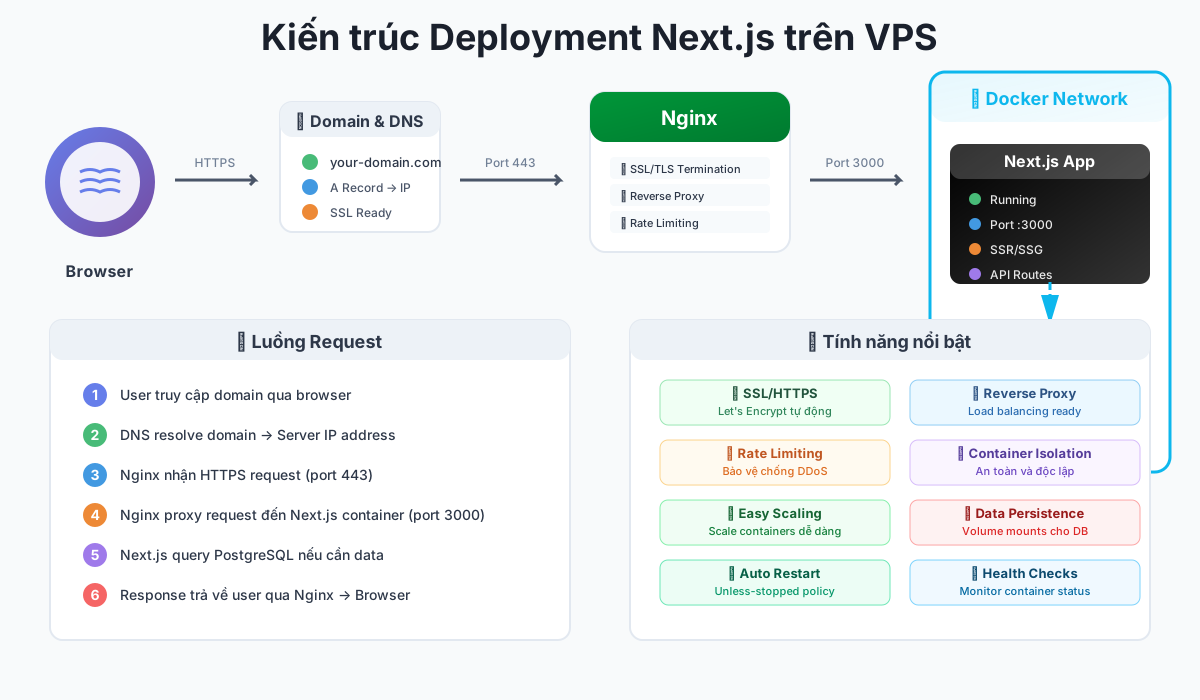
Request flow:
User → Domain → DNS → Nginx (Port 80/443)
                        ↓
                   Docker Network
                        ↓
              ┌─────────┴─────────┐
              ↓                   ↓
         Next.js App         PostgreSQL DB
        (Port 3000)         (Port 5432)
Components:
- Nginx: Reverse proxy, handles SSL, serves static files
- Next.js container: Runs the Next.js application
- PostgreSQL container: Database server
- Docker network: Connects the containers
Server Setup
1. SSH into the server
ssh root@your_server_ip
# or if you use a non-root user
ssh user@your_server_ip
2. Update the system
sudo apt update && sudo apt upgrade -y
3. Install basic packages
sudo apt install -y curl wget git build-essential
Install Docker and Docker Compose
Install Docker
# Remove old versions
for pkg in docker.io docker-doc docker-compose docker-compose-v2 podman-docker containerd runc; do sudo apt-get remove $pkg; done

# Add Docker's official GPG key:
sudo apt-get update
sudo apt-get install ca-certificates curl
sudo install -m 0755 -d /etc/apt/keyrings
sudo curl -fsSL https://download.docker.com/linux/ubuntu/gpg -o /etc/apt/keyrings/docker.asc
sudo chmod a+r /etc/apt/keyrings/docker.asc

# Add the repository to Apt sources:
echo \
  "deb [arch=$(dpkg --print-architecture) signed-by=/etc/apt/keyrings/docker.asc] https://download.docker.com/linux/ubuntu \
  $(. /etc/os-release && echo "${UBUNTU_CODENAME:-$VERSION_CODENAME}") stable" | \
sudo tee /etc/apt/sources.list.d/docker.list > /dev/null
sudo apt-get update

# Install latest version
sudo apt-get install docker-ce docker-ce-cli containerd.io docker-buildx-plugin docker-compose-plugin

# Start Docker service
sudo systemctl status docker
sudo systemctl start docker

# Verify installation
docker --version
Add your user to the docker group (optional)
sudo usermod -aG docker $USER
newgrp docker
Nginx Setup
This section shows how to install and configure Nginx on Ubuntu 20.04, following the official DigitalOcean guide.
Install Nginx
# Update package index
sudo apt update

# Install Nginx
sudo apt install nginx

# Verify installation
nginx -v
Adjust the firewall
Before testing Nginx, adjust the firewall to allow traffic:
# Check firewall status
sudo ufw status

# If the firewall is not active, enable it
sudo ufw enable

# Allow OpenSSH (important – otherwise you may lock yourself out)
sudo ufw allow 'OpenSSH'

# Allow Nginx traffic
sudo ufw allow 'Nginx Full'
# Or allow HTTP/HTTPS separately:
# sudo ufw allow 'Nginx HTTP'
# sudo ufw allow 'Nginx HTTPS'

# Or allow by port:
# sudo ufw allow 80/tcp
# sudo ufw allow 443/tcp

# Verify firewall rules
sudo ufw status
WARNING
Important: Always allow OpenSSH before enabling the firewall, or you may lock yourself out of the server!
Check the web server
After installing and configuring the firewall:
# Check Nginx status
sudo systemctl status nginx

# If it's not running, start Nginx
sudo systemctl start nginx

# Enable Nginx to start automatically on reboot
sudo systemctl enable nginx
Verify that Nginx is working:
- Visit
http://your_server_ipin your browser - Or use curl:
curl http://localhost
You should see the Nginx welcome page if the installation was successful.
Manage the Nginx process
Common commands to manage Nginx:
| Command | Description |
|---|---|
sudo systemctl stop nginx | Stop Nginx |
sudo systemctl start nginx | Start Nginx |
sudo systemctl restart nginx | Restart Nginx |
sudo systemctl reload nginx | Reload config without stopping the service |
sudo systemctl status nginx | Check status |
sudo systemctl disable nginx | Disable auto‑start |
sudo systemctl enable nginx | Enable auto‑start |
Reload vs Restart:
reload: Load new configuration without dropping connections (recommended for production)restart: Stop and start the service (may drop connections)
Configure server blocks
Server blocks let you host multiple domains on one server. Create a server block for your Next.js app:
# Create a config file for your domain
sudo nano /etc/nginx/sites-available/your-domain.com
Basic server block config for Next.js:
server {
    listen 80;
    listen [::]:80;

    server_name your-domain.com www.your-domain.com;

    # Logging
    access_log /var/log/nginx/your-domain.access.log;
    error_log /var/log/nginx/your-domain.error.log;

    location / {
        proxy_pass http://localhost:3000;
        proxy_http_version 1.1;
        proxy_set_header Upgrade $http_upgrade;
        proxy_set_header Connection 'upgrade';
        proxy_set_header Host $host;
        proxy_set_header X-Real-IP $remote_addr;
        proxy_set_header X-Forwarded-For $proxy_add_x_forwarded_for;
        proxy_set_header X-Forwarded-Proto $scheme;
        proxy_cache_bypass $http_upgrade;
    }
}
Enable the server block
After creating the config file:
# Create a symbolic link to enable the site
sudo ln -s /etc/nginx/sites-available/your-domain.com /etc/nginx/sites-enabled/

# Test Nginx config (important – check syntax)
sudo nginx -t

# If the test passes, reload Nginx
sudo systemctl reload nginx

# Remove default site (optional)
sudo rm /etc/nginx/sites-enabled/default
Important Nginx files and directories
| File/Directory | Description |
|---|---|
/etc/nginx/nginx.conf | Main Nginx config file |
/etc/nginx/sites-available/ | Contains (inactive) server block configs |
/etc/nginx/sites-enabled/ | Symbolic links to active server blocks |
/var/www/html/ | Default web root directory |
/var/log/nginx/access.log | Access logs |
/var/log/nginx/error.log | Error logs |
/etc/nginx/snippets/ | Reusable config snippets |
Validate the configuration
# Test configuration (always run before reload – very important)
sudo nginx -t

# If there are errors, check the error log
sudo tail -f /var/log/nginx/error.log

# View access log
sudo tail -f /var/log/nginx/access.log
TIP
Always run sudo nginx -t before reloading/restarting Nginx to avoid taking the server down due to a bad config!
Configure the Next.js Application
1. Clone the repository
git clone https://github.com/leerob/next-self-host.git
cd next-self-host
2. Project structure
Based on the next-self-host repo, the project has the following structure:
next-self-host/
├── app/                   # Next.js app directory
├── public/                # Static files
├── Dockerfile             # Container definition
├── docker-compose.yml     # Multi-container setup
├── deploy.sh              # Deployment script
├── update.sh              # Update script
├── next.config.ts         # Next.js configuration
├── package.json           # Dependencies
└── .env                   # Environment variables
3. Dockerfile
Sample Dockerfile for a Next.js app:
FROM oven/bun:alpine AS base
# Stage 1: Install dependencies
FROM base AS deps
WORKDIR /app
COPY package.json bun.lockb ./
RUN bun install --frozen-lockfile
# Stage 2: Build the application
FROM base AS builder
WORKDIR /app
COPY /app/node_modules ./node_modules
COPY . .
RUN bun run build
# Stage 3: Production server
FROM base AS runner
WORKDIR /app
ENV NODE_ENV=production
COPY /app/public ./public
COPY /app/.next/standalone ./
COPY /app/.next/static ./.next/static
EXPOSE 3000
CMD ["bun", "run", "server.js"]
4. docker-compose.yml
services:
    web:
        build: .
        ports:
            - "3000:3000"
        environment:
            - NODE_ENV=production
        depends_on:
            - db
        networks:
            - my_network

    db:
        image: postgres:latest
        environment:
            POSTGRES_USER: ${POSTGRES_USER}
            POSTGRES_PASSWORD: ${POSTGRES_PASSWORD}
            POSTGRES_DB: ${POSTGRES_DB}
        ports:
            - "5432:5432"
        volumes:
            - postgres_data:/var/lib/postgresql/data
        networks:
            - my_network

    cron:
        image: alpine/curl
        command: >
            sh -c "
              echo '*/10 * * * * curl -X POST http://web:3000/db/clear' > /etc/crontabs/root && \
              crond -f -l 2
            "
        depends_on:
            - web
        networks:
            - my_network

volumes:
    postgres_data:

networks:
    my_network:
        name: my_network
        driver: bridge
Configure PostgreSQL
Database setup
After the containers are running, set up the database schema:
# Enter the PostgreSQL container
docker exec -it myapp-db-1 sh

# Install PostgreSQL client
apk add --no-cache postgresql-client

# Connect to the database
psql -U myuser -d mydatabase

# Create a table (example)
CREATE TABLE IF NOT EXISTS "todos" (
  "id" serial PRIMARY KEY NOT NULL,
  "content" varchar(255) NOT NULL,
  "completed" boolean DEFAULT false,
  "created_at" timestamp DEFAULT now()
);
Using Drizzle ORM
If your project uses Drizzle (like in the repo):
# Install dependencies
npm install

# Run migrations
npm run db:migrate

# Or use Drizzle Studio
npm run db:studio
Deploy Script
The deploy script automates the entire deployment process. It’s based on deploy.sh from the repo:
Steps performed by the script:
| Step | Task | Details |
|---|---|---|
| 1. Setup packages | Install dependencies | curl, git, Docker, Docker Compose, Nginx |
| 2. Clone repository | Download source code | Clone from GitHub or from local |
| 3. Generate SSL | Create SSL certificate | Use Certbot (Let's Encrypt) |
| 4. Build application | Build the Next.js app | Docker build with the Dockerfile |
| 5. Configure Nginx | Setup reverse proxy | Configure HTTPS and rate limiting |
| 6. Setup database | Initialize PostgreSQL | Create database and tables |
| 7. Start services | Start containers | docker-compose up -d |
| 8. Setup cron | Automated tasks | Periodic jobs (optional) |
Using the deploy script
# Download the script
curl -o ~/deploy.sh https://raw.githubusercontent.com/leerob/next-self-host/main/deploy.sh

# Edit variables
nano ~/deploy.sh
# Change: EMAIL, DOMAIN_NAME

# Run the script
chmod +x ~/deploy.sh
./deploy.sh
Example deploy.sh (custom)
#!/bin/bash

set -e

# Configuration
EMAIL="your-email@example.com"
DOMAIN="your-domain.com"
PROJECT_DIR="/opt/nextjs-app"

echo "Starting deployment..."

# Update system
apt update && apt upgrade -y

# Install Docker
curl -fsSL https://get.docker.com -o get-docker.sh
sh get-docker.sh

# Install Docker Compose
curl -L "https://github.com/docker/compose/releases/latest/download/docker-compose-$(uname -s)-$(uname -m)" -o /usr/local/bin/docker-compose
chmod +x /usr/local/bin/docker-compose

# Install Nginx
apt install -y nginx

# Clone repository
git clone https://github.com/leerob/next-self-host.git $PROJECT_DIR
cd $PROJECT_DIR

# Generate SSL certificate
apt install -y certbot python3-certbot-nginx
certbot --nginx -d $DOMAIN --non-interactive --agree-tos -m $EMAIL

# Build and start containers
docker-compose build
docker-compose up -d

echo "Deployment completed!"
SSL Certificate with Let's Encrypt
Install Certbot
sudo apt install -y certbot python3-certbot-nginx
Generate SSL certificate
# Automatic configuration with Nginx
sudo certbot --nginx -d your-domain.com

# Or only generate the certificate
sudo certbot certonly --nginx -d your-domain.com
Auto-renewal
Certbot automatically sets up a cron job to renew the certificate:
# Test renewal
sudo certbot renew --dry-run

# Check renewal status
sudo systemctl status certbot.timer
Rate Limiting and Security
Nginx rate limiting
Configure rate limiting in Nginx to protect the server:
# /etc/nginx/nginx.conf
http {
    limit_req_zone $binary_remote_addr zone=api_limit:10m rate=10r/s;

    server {
        location /api {
            limit_req zone=api_limit burst=20 nodelay;
            proxy_pass http://localhost:3000;
        }
    }
}
Security headers
Add security headers in the Nginx config:
server {
    # SSL configuration
    ssl_certificate /etc/letsencrypt/live/your-domain.com/fullchain.pem;
    ssl_certificate_key /etc/letsencrypt/live/your-domain.com/privkey.pem;

    # Security headers
    add_header X-Frame-Options "SAMEORIGIN" always;
    add_header X-Content-Type-Options "nosniff" always;
    add_header X-XSS-Protection "1; mode=block" always;
    add_header Strict-Transport-Security "max-age=31536000; includeSubDomains" always;

    # Proxy settings
    location / {
        proxy_pass http://localhost:3000;
        proxy_http_version 1.1;
        proxy_set_header Upgrade $http_upgrade;
        proxy_set_header Connection 'upgrade';
        proxy_set_header Host $host;
        proxy_set_header X-Real-IP $remote_addr;
        proxy_set_header X-Forwarded-For $proxy_add_x_forwarded_for;
        proxy_set_header X-Forwarded-Proto $scheme;
        proxy_cache_bypass $http_upgrade;
    }
}
Firewall configuration
# Install UFW (if not installed)
sudo apt install -y ufw

# Allow SSH
sudo ufw allow 22/tcp

# Allow HTTP and HTTPS
sudo ufw allow 80/tcp
sudo ufw allow 443/tcp

# Enable firewall
sudo ufw enable

# Check status
sudo ufw status
Updates and Maintenance
Update script
Use update.sh to update the application:
#!/bin/bash

set -e

cd /opt/nextjs-app

# Pull latest code
git pull origin main

# Rebuild containers
docker-compose build

# Restart services
docker-compose up -d

# Clean up old images
docker image prune -f

echo "Update completed!"
Maintenance commands
| Purpose | Command | Description |
|---|---|---|
| Check containers | docker-compose ps | View container status |
| View logs | docker-compose logs web | View logs of the Next.js app |
| View DB logs | docker-compose logs db | View PostgreSQL logs |
| Restart services | docker-compose restart | Restart all services |
| Stop services | docker-compose down | Stop and remove containers |
| Start services | docker-compose up -d | Start containers in the background |
| Restart Nginx | sudo systemctl restart nginx | Restart Nginx |
| Enter Next.js container | docker exec -it myapp-web-1 sh | Enter the app container |
| Enter DB container | docker exec -it myapp-db-1 psql -U user -d db | Enter PostgreSQL CLI |
Backup strategy
| Backup type | Frequency | How to perform |
|---|---|---|
| Database backup | Daily | pg_dump or Docker volume backup |
| Application code | Per deployment | Git repository |
| Environment variables | On changes | Secure storage (vault, encrypted file) |
| Docker volumes | Weekly | Volume backup scripts |
Backup database
# Backup PostgreSQL
docker exec myapp-db-1 pg_dump -U myuser mydatabase > backup_$(date +%Y%m%d).sql

# Restore from backup
docker exec -i myapp-db-1 psql -U myuser mydatabase < backup_20250101.sql
Troubleshooting
Common issues
| Issue | Possible cause | Solution |
|---|---|---|
| Container not starting | Docker service not running | sudo systemctl start docker |
| Port already in use | Ports 3000/80/443 are taken | sudo lsof -i :3000 and kill the process |
| SSL certificate fail | DNS not yet propagated | Wait for DNS update, check with dig your-domain.com |
| Database connection error | Wrong connection string | Check DATABASE_URL in .env |
| Nginx 502 Bad Gateway | Next.js app not running | Check docker-compose logs web |
| Build failed | Dependency issues | Delete node_modules and rebuild |
| Permission denied | User lacks permissions | sudo chown -R user:user /opt/nextjs-app |
Debug commands
# Check Docker containers
docker ps -a

# Check Docker logs
docker-compose logs --tail=100 web

# Check Nginx logs
sudo tail -f /var/log/nginx/error.log
sudo tail -f /var/log/nginx/access.log

# Check system resources
htop
df -h  # Disk space
free -h  # Memory

# Check network
sudo netstat -tulpn | grep :3000
sudo netstat -tulpn | grep :80
Common fixes
Issue: Next.js app not responding
# Restart containers
docker-compose restart

# Rebuild containers
docker-compose build --no-cache
docker-compose up -d
Issue: Database connection refused
# Check database container
docker-compose ps db

# Check database logs
docker-compose logs db

# Verify connection string
docker exec myapp-web-1 env | grep DATABASE_URL
Issue: SSL certificate not renewing
# Manual renewal
sudo certbot renew

# Check certificate expiry
sudo certbot certificates
Best Practices
1. Environment Variables
| Biến | Mô tả | Bảo mật |
|---|---|---|
DATABASE_URL | PostgreSQL connection string | ✅ Không commit vào Git |
NODE_ENV | Environment (production/development) | ✅ Set trong Docker |
NEXT_PUBLIC_* | Public environment variables | ⚠️ Sẽ exposed trong client |
API_KEYS | Third-party API keys | ✅ Không expose public |
Security:
- Sử dụng
.envfile và thêm vào.gitignore - Không commit sensitive data
- Sử dụng secrets management (AWS Secrets, Vault)
2. Docker Best Practices
| Practice | Lý do | Implementation |
|---|---|---|
| Multi-stage builds | Giảm image size | Separate build và runtime stages |
| Non-root user | Security | Run container với non-root user |
| .dockerignore | Faster builds | Exclude node_modules, .git |
| Health checks | Auto-recovery | Healthcheck trong docker-compose |
| Resource limits | Prevent resource exhaustion | Set CPU/memory limits |
3. Next.js Optimization
| Feature | Benefit | Configuration |
|---|---|---|
| Image Optimization | Reduce bandwidth | Next/Image với image loader |
| Static Generation | Faster pages | generateStaticParams |
| ISR (Incremental Static Regeneration) | Fresh content | revalidate option |
| Caching | Better performance | Cache headers, Redis |
| Middleware | Request processing | middleware.ts |
4. Monitoring
Setup monitoring để theo dõi:
| Metric | Tool | Purpose |
|---|---|---|
| Server Resources | htop, Prometheus | CPU, RAM, Disk usage |
| Application Logs | Docker logs, ELK | Debug và error tracking |
| Uptime | UptimeRobot, Pingdom | Monitor availability |
| Performance | New Relic, Datadog | APM monitoring |
| Errors | Sentry | Error tracking |
5. Backup và Disaster Recovery
| Component | Backup Method | Frequency |
|---|---|---|
| Database | pg_dump | Daily |
| Docker Volumes | Volume backup | Weekly |
| Configuration Files | Git repository | On changes |
| SSL Certificates | Let's Encrypt auto-renew | Automatic |
6. Security Checklist
- ✅ Keep system updated
- ✅ Use strong passwords
- ✅ Enable firewall (UFW)
- ✅ SSH key authentication (disable password)
- ✅ Regular security audits
- ✅ Monitor logs for suspicious activity
- ✅ Use HTTPS only
- ✅ Security headers trong Nginx
- ✅ Rate limiting
- ✅ Database access restrictions
Kết luận
Deploy Next.js lên VPS là một quá trình phức tạp nhưng mang lại nhiều lợi ích: kiểm soát hoàn toàn, chi phí linh hoạt và học hỏi về infrastructure. Với Docker và Nginx, bạn có thể setup một production-ready deployment tương tự như các managed platforms.
Điểm mấu chốt
- ✅ Docker simplifies deployment - Containerization giúp dễ quản lý và scale
- ✅ Nginx as reverse proxy - Xử lý SSL, static files, và load balancing
- ✅ PostgreSQL for data - Reliable database solution
- ✅ Automation is key - Deploy scripts giúp tiết kiệm thời gian
- ✅ Security matters - SSL, firewall, và monitoring là bắt buộc
Tài nguyên tham khảo
- 📦 next-self-host Repository - Source code mẫu
- 📹 Self Hosting Tutorial Video - Video hướng dẫn chi tiết
- 📚 Next.js Deployment Docs
- 🐳 Docker Documentation
- 🌐 Nginx Documentation
Bước tiếp theo
- Setup VPS: Mua và cấu hình VPS server
- Deploy thử nghiệm: Chạy deploy script trên test environment
- Customize: Tùy chỉnh theo nhu cầu của bạn
- Monitor: Setup monitoring và alerting
- Optimize: Tối ưu performance và costs
TIP
Bắt đầu với staging: Trước khi deploy production, hãy test trên staging environment để đảm bảo mọi thứ hoạt động đúng!