- Published on
How I Learned System Design
- Authors

- Name
- Himanshu Singour
– The honest journey from total confusion to clarity
- 1. First, I Accepted I Knew Nothing and That Was Okay
- 2. I Broke Down "System Design" Into Mini Topics
- 3. I Watched Real People Think, Not Just Teach
- 4. I Started Drawing Even If It Was Just on Paper
- 5. I Practiced With Real System Design Problems
- 6. I Applied It at Work
- 7. I Started Explaining to Others
- My Honest Advice to You
- Final Thought: It's Not About Answers; It's About Approach
- If you made it till here, thank you ❤️
Let me be brutally honest with you.
There was a time I used to skip every video or blog that said "System Design". I'd think, "This is for senior engineers, architects, not for me."
I was wrong.
Because one day, in an interview, they asked me: "Can you design a ride-sharing app like Uber?" And I froze.
I talked about REST APIs. I mentioned MySQL. Then… silence. No clue how to handle scale, no idea about queues, or even how to store real-time location.
That day I decided this won't happen again. Here's how I went from being totally lost to confidently discussing architecture in interviews, and even proposing better designs at work.
1. First, I Accepted I Knew Nothing and That Was Okay
System Design is intimidating at first. People throw words like "sharding", "CQRS", "load balancer", "eventual consistency"…
At first, it made me feel dumb. But then I realized Everyone feels lost in the beginning.
System design isn't a single topic. It's not a "chapter" you can complete in a week. It's a mix of:
- How data flows
- How services talk to each other
- How systems survive under huge traffic
- And how to make things fault-tolerant, fast, and reliable
Once I accepted that this will take time, it felt lighter. I stopped chasing perfection and focused on small wins.
2. I Broke Down "System Design" Into Mini Topics
System Design is not one big subject; it's a set of interconnected building blocks. So I made a map for myself:
a) The Basics
- What happens when you type a URL in the browser
- What is DNS, Load Balancer, CDN
- TCP vs UDP, HTTP vs HTTPS
Even these basics were eye-opening. Like Did you know DNS is like a phonebook of the internet? And CDNs are why YouTube loads fast?
b) Data and Storage
- SQL vs NoSQL
- Indexing, Replication, Sharding
- When to choose MongoDB vs PostgreSQL
I learned this the hard way. In one project, we chose Mongo for transactional data. Later, we regretted it.
c) Scaling Techniques
- Horizontal vs Vertical scaling
- Caching (Redis, Memcached)
- Load balancing (Round-robin, IP Hashing)
I loved this part. It made me feel like I could finally design something for millions of users even if it was just on paper.
d) Architecture Patterns
- Monolith vs Microservices
- Event-Driven Architecture
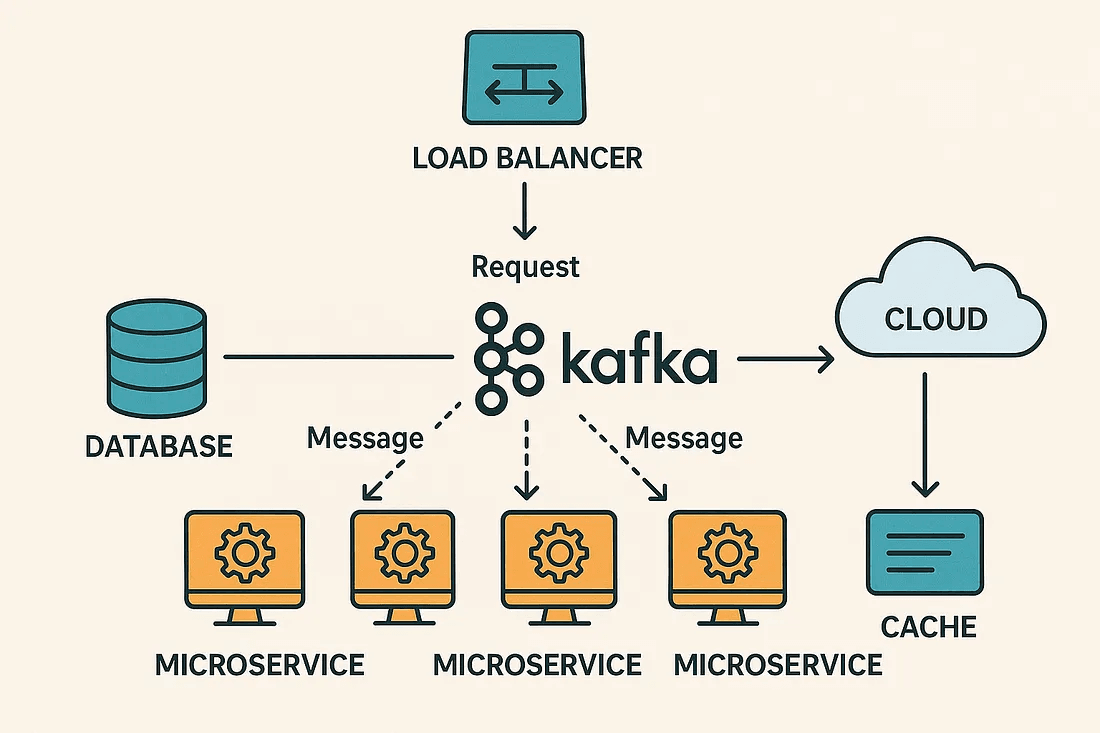
- Pub/Sub, Message Queues (Kafka, RabbitMQ)
This made me understand why companies like Netflix use microservices not just because it's trendy, but because it makes sense at scale.
3. I Watched Real People Think, Not Just Teach
Instead of watching tutorial-style videos, I started watching mock interviews.
And trust me, that changed everything.
Because when someone thinks aloud, makes mistakes, backtracks, and justifies their choices, you learn how to think, not just copy.
Channels that really helped:
- Gaurav Sen explains from the ground up
- Exponent mock interviews with real candidates
- ByteByteGo visual, storytelling approach
I learned how to:
- Ask the right clarifying questions
- Define functional and non-functional requirements
- Walk through API design, DB choices, scaling logic
- Always talk about tradeoffs, not just choices
4. I Started Drawing Even If It Was Just on Paper
One surprising thing that helped me? Drawing.
I'm not an artist. But sketching out a flow from client → load balancer → app servers → DB made it click.
When I drew:
- The request flow felt real
- I saw where bottlenecks could happen
- I understood where to place a cache, when to use a queue
Even today, when I'm stuck, I grab a pen and paper. That sketch often gives me the clarity that reading never did.
5. I Practiced With Real System Design Problems
Once I was confident with basics, I stopped watching and started designing.
Here's how I practiced:
- Pick a real-world system: WhatsApp, YouTube, Zomato, Instagram
- Write the functional requirements first (what the system should do)
- Then add non-functional requirements (scale, availability, latency)
- Do rough estimation (users, QPS, DB size)
- Design a high-level architecture
Go deeper into:
- DB schema
- APIs
- Scaling strategies
- Handling failures
- Edge cases
I wrote one design per week. And not just one solution but multiple possibilities.
Because in real interviews (and real jobs), there's rarely one perfect answer. It's all about justifying why you picked X over Y.
6. I Applied It at Work
Theory is useless unless you apply it.
At work, I was working on a high-traffic service for EMI generation. It had Kafka events, REST APIs, complex transactions.
This is where I started applying design principles:
- I proposed breaking a monolith into services
- Used queues for async communication
- Introduced retries and dead-letter queues
- And even debated Kafka vs gRPC (based on latency and control)
It wasn't perfect. But it gave me confidence that system design isn't just interview stuff; it's a real, valuable skill that helps your team and your product.
7. I Started Explaining to Others
This was the final level.
When you explain something—be it to a junior, an intern, or in a blog—you spot the gaps in your own understanding.
So I:
- Mentored juniors during onboarding
- Took small sessions to explain caching, DB design, and queues
- Wrote articles with diagrams
- Started preparing juniors for design interviews
Every time I explained something, I realized: If I can teach it simply, I actually understand it well.
My Honest Advice to You
If you're starting today, or if you've failed in your first design interview, I want to tell you this:
IMPORTANT
System Design is not magic. You don't need 10 years of experience. You don't need to memorize Gaurav Sen's diagrams.
You just need to:
- Start with basics
- Think in real-world use cases
- Build a structure
- Practice weekly
- Ask "why" behind every choice
- And slowly improve
Even if you give 30 minutes daily, in 3 months, you'll see the difference.
Final Thought: It's Not About Answers; It's About Approach
In system design, you'll often feel uncertain. That's normal. What matters is how you approach a problem.
When you explain:
- What's the scale?
- What's the bottleneck?
- What are the tradeoffs of this DB vs that one?
- What if this service fails?
That's what makes you a strong engineer. Not the number of diagrams you memorized.
So keep going. Start with "How does a URL work?" and end with designing Instagram.
You'll be amazed at how far you've come—one system at a time.
If you made it till here, thank you ❤️
I'm sharing more such learnings from real backend on my journey.